

Introduction
In 2024, Alpaca evolved in significant ways, from a company focused primarily on teacher appreciation and recognition through our “Alpaca packs” to a complete solution for educator wellbeing, including software to survey and listen to teachers, resources to support them, and celebrations to recognize educators’ efforts. In 2025, we’ll double down on the opportunity to bring our unique semantic pulse survey solution to schools and districts across the country, scaling our growth and building the next generation of wellbeing tools for educators.
History
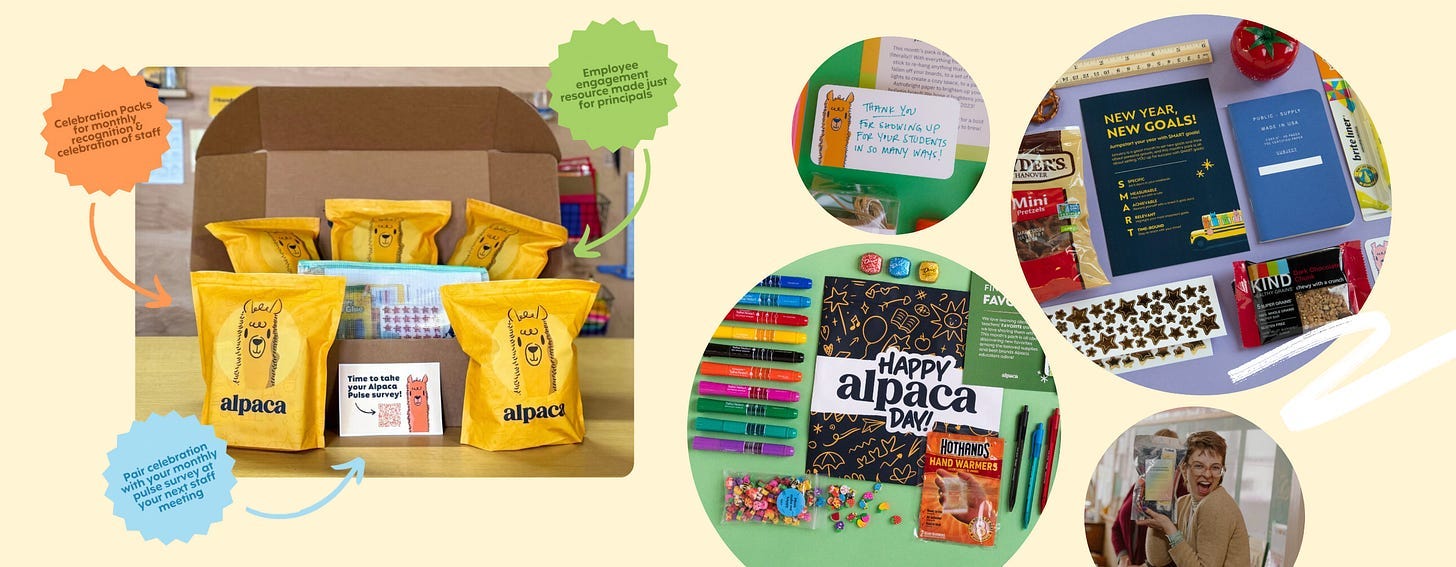
When Alpaca started in 2022, we offered schools a simple idea: support your teachers’ wellbeing once a month with a subscription “pack” aimed at reducing out of pocket spend and infusing a bit of gratitude into a teacher’s day. To help schools pay for it, we built a parent-paid fund for each school. In our first year, the model quickly evolved toward schools and districts paying for this unique teacher recognition program, taking the burden off of parents and looking at teacher recognition as a key component of a school’s teacher retention strategy.
Over the next two years, Alpaca delivered thousands of recognition packs to teachers in schools across the Midwest. The overwhelmingly positive feedback was useful, but even more telling was the data we received from our satisfaction surveys. These surveys not only asked educators what they needed more of (or less of) from our packs, they also asked how teachers were doing, in their own words. In October, 2023, we found that we’d amassed more than 16,000 sentiments and comments from real teachers about how they felt at work and what they needed the most. We knew there was an opportunity ahead of us.
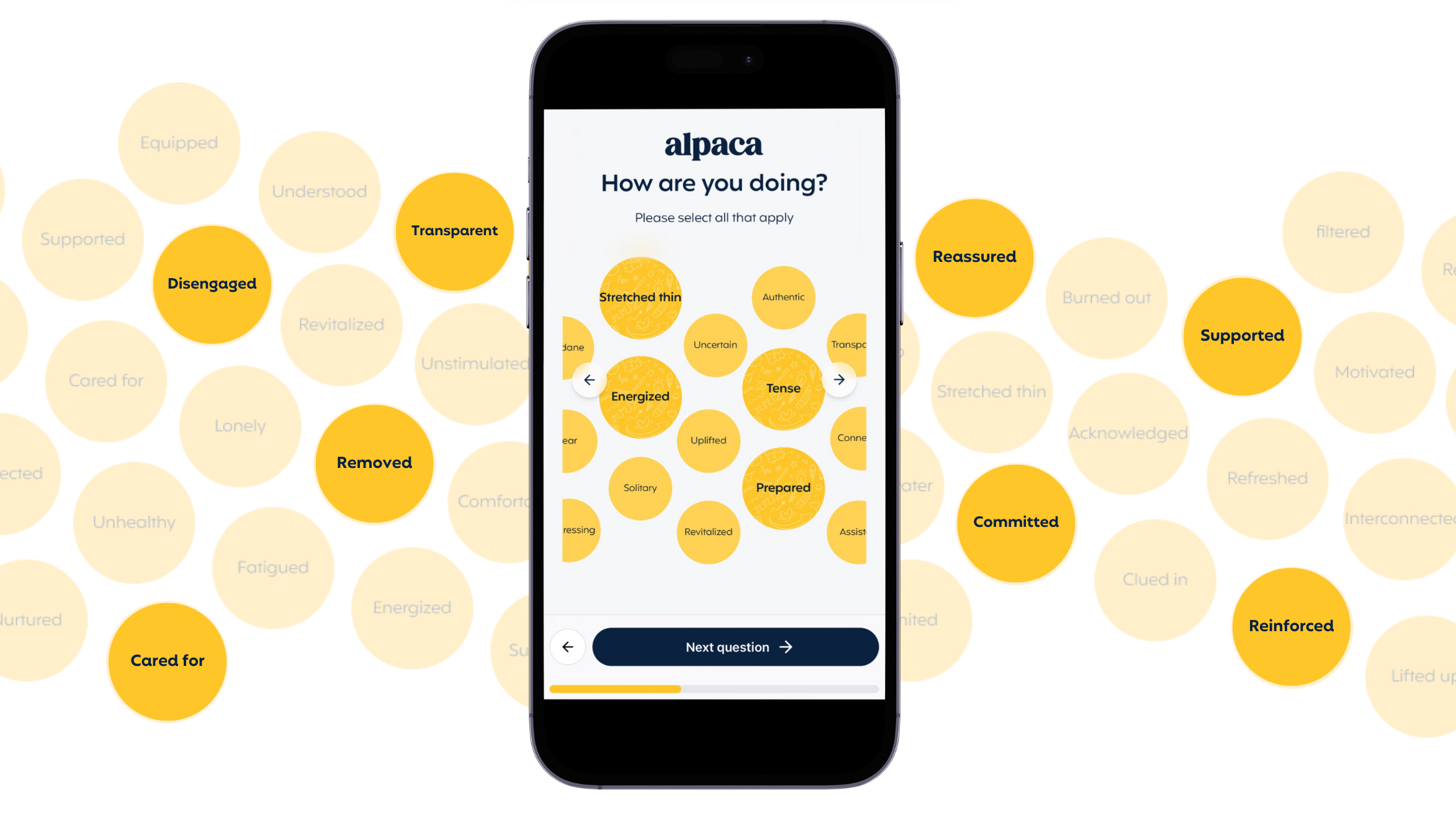
From this data set, Alpaca created a framework for listening to teachers that we call “semantic pulse surveys.” “Semantic" because we ask the real words teachers use, and “pulse” because it takes just one minute, once a month. This model asks the real words teachers use to describe work, and then analyzes them for sentiment using our research-backed framework for teacher wellbeing. It’s simple, and it’s powerful.
In 2024, Alpaca launched Alpaca Pulse, a brand new way for school leaders to listen to their educators and provide real and lasting support to their entire team. We launched the product in August 2024 and grew from 18 paying customers to 85 in the last two quarters of the year.
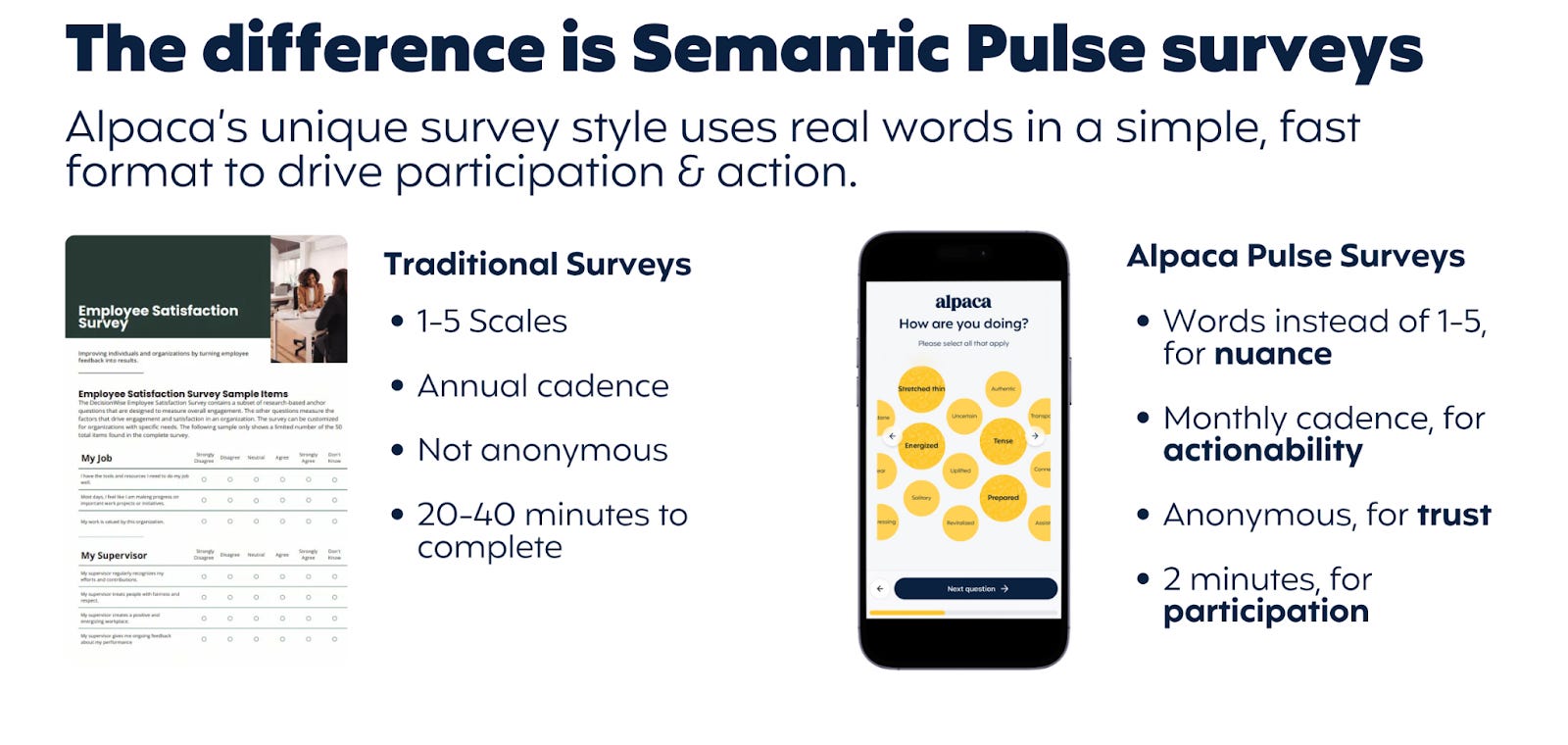
The adoption of this product is overwhelming! Our school principals feel “better at being a leader” and our district staff claim they’ve “never seen data like this before” and that they “use it every day to support their teams.”
Now, we have an opportunity ahead of us. With 85+ customers and a growing database of teacher wellbeing sentiment, Alpaca is poised to establish ourselves as a company who leads the conversation around teacher wellbeing and retention, while delivering extraordinary and delightful solutions to address it. We’re here to help principals become better leaders, and teachers feel amazing at their workplaces. Alpaca is here to become the employee engagement platform for K-12 educators.
In 2025, Alpaca will continue down this path, by co-designing excellent products for employee engagement alongside innovative school districts, building our understanding of teacher wellbeing, and creating delightful ways of celebrating the profession of education. It’s going to be a big year. The following outlines our work and learnings in 2024, and our strategies for 2025.
2024 Highlights
Alpaca had a big year in 2024! We found the beginnings of product market fit in our new offering, Alpaca Pulse, alongside a strategy for selling it that resonates with our school customers and our district HR teams. Here are the highlights:
Alpaca added $205K in ARR in 2024, bringing on 70+ new schools and districts, expanding our reach and building new data around teacher morale.
We built and launched Alpaca Pulse, our first software offering, giving schools and districts a new way to listen to and support their educators.
Alpaca expanded to 24 states! We’re so excited to see educators from around the country join our community.
We piloted Substitute Surveys, co-designing an emerging product alongside our customer at High Desert Educational Service District and our friends at Red Rover.
We created a new partnership with the Nebraska Early Childhood Collective, which will build out our teacher wellbeing system for early childhood educators across our state.
We collected more than 30,000 insights from real educators around the country telling us how they’re doing, what they need, and what helps them the most right now. It’s the only dataset of its kind, and we believe it has huge potential for impact.
Alpaca supported more than 7,500 educators every month with our unique system of pulse surveys and celebrations for educators.
We grew our Little Wins newsletter for school principals from 400 to 7,500 subscribers! That means Alpaca’s resources and celebrations reach thousands of educators every single week.
We grew our library of educator resources from just three to more than 130. Some of our most popular tools and resources now rank at the top of google searches for educators looking for ways to build school culture and improve team morale.
Alpaca’s leaders spoke on stage at 2 major education conferences this year, bringing ideas around semantic pulse surveys to new audiences.
Alpaca was featured on the Cult of Pedagogy podcast to talk about semantic pulse surveys and Jennifer Gonzalez was the MOST fun to work with.

Alpaca shipped 18,815 celebration packs to educators around the United States (and Canada!) this year.
2025 Goals
In 2025, Alpaca has four key goals, with several initiatives under each one to accomplish them. They are:
Achieve $1.4M in ARR through sales to both school and districts by:
Increasing value school districts through product co-design
Increasing sales volume for school leaders with simple pricing and concise product offerings
Building a sales team to execute the sales process we proved out in 2024
Increasing lead flow through in-person events, Alpaca Resources demand gen, thought leadership, and email nurture.
Launch an additional, sellable product or extension for school leaders
Publish original research on teacher wellbeing in order to solidify Alpaca as an expert in the space of employee engagement for educators.
Support our company with the team members, financial strength, and knowledge to set our company up for long term success.
Customer strategies for 2025
There are two keys to success in 2025 – increasing volume and velocity of sales to customers, and co-designing our future products alongside our customers.
Increasing volume and scale for school customers
Our volume and velocity strategy centers around our school customers, where we sell to school principals. We have proven a sales motion here with the addition of 60 school customers in 2024. These customers are primarily purchasing a combination of Alpaca Pulse and our Celebration Packs, as a “complete solution for teacher recognition.” The customer here is primarily school principals, who have the decision making capability and the budget for Alpaca for the year. These sales are often accomplished in 1-2 calls, and at this price point, don’t require additional permission or authorization.
Expanding this line of business will require formalizing a sales team now that we’ve built a proven sales process and increasing our volume and velocity of sales activities. This will help us grow our school-level business.
The strategies we put in place here are:
Outreach to every principal in a “live” district: If we have one principal who is a customer, we have the opportunity to have more in that district. And we have some damn good live districts right now. Yes, we can also then reach out to district leaders, but in the short term, bringing Alpaca to more principals one by one is plenty of opportunity. We have about 70 school customers now, and about 60 of those are in public school districts. If each of those districts had just 15-20 more principals in the district we could talk to, that’s at least 1,000 leads right there. Let’s get after it.
Resources & Little Wins, with greater followup: We know principals love our resources. Let’s share them more, promote them more, highlight principals who are using them, and keep delivering free value to principals. THEN, let’s follow up with marketing cadences and sales emails and ask for them to consider Alpaca for the school year ahead.
Simplified pricing and offering: Let’s make this as easy as possible for our principals. Our spring pilot is easy to say yes to — it’s one price, and you get the whole kit-and-kaboodle. We can always alter/amend an offering for a specific customer need. But for our school level customer, let’s just make it a simple program with a single price. You get packs, pulse, and resources. Yay.
Formalize a BDR sales motion: Last year, we built a basic sales playbook — meet potential customers at a conference, book a demo, send a proposal, sign a contract. It worked and we love that. But it was all reliant on being live at conferences — that was our main channel IN. Time for us to find new avenues, in addition to conferences — preferably higher volume ones. That will include a dedicate role (or roles) that emphasize focused outbound calling every day, increasing our use of sales chat on our website, more frequent email outreach, and geographically focused prospecting. I don’t think we know what velocity or volume is possible until we try this.
At the same time, Alpaca will advance our product in order to increase our overall contract value, and begin to support a larger number of district customers. The following delineates the strategies for each.
Co-designing our future product with customers
To increase the value we provide to customers and broaden the opportunity to sell to more schools and districts, I believe we need to co-design Alpaca’s next offerings and products with district level leaders in order to solve key challenges around teacher retention and wellbeing.
Right now, Alpaca has an extraordinary opportunity to co-design the next few things on our product roadmap alongside early customers. We did this last year with High Desert Educational Services District and I think we can repeat that process again! The steps we’ll take look like this:
Get exploratory conversations with customers and school district teams that we believe are our buyers.
LISTEN and understand more about what problem they’re motivated to solve.
Understand some things: What have they tried? Have they given up on that problem? For us, the sweet spot is: They’ve tried, they’ve failed, they haven’t given up, and they still have the problem.
Bring ideas for how we solve that problem to them to see what resonates.
Opportunities for Our Products
Overall, we want to explore more opportunities for districts to support their educators in finding autonomy, purpose, mobility, connection, and voice at work. Here are several ideas we have for this:
Substitute management: surveys and recognition programs to attract and retain substitute teachers in the face of shrinking substitute pools everywhere.
Educator feedback/ classroom observation: utilize semantic pulse framework to give principals a simple way to observe a classroom or check in with a teacher and quickly provide semantic-based feedback, and offer encouragement to the educator.
Principal people management tools. We know that most principals don’t have a lot of the tools and training around “people management” that managers in the private sector have, and yet they’re asked to manage 50+ direct reports each day. Alpaca’s core product borrows the ideas around employee engagement from the private sector in our surveys and recognition products. What else might we provide to those principals to help them be successful people managers? I want to find out.
Mental health tools for educators. I don’t know exactly what this looks like yet, but I do know that mental health challenges for educators are on the rise. We already gather extraordinary data about how teachers ARE doing. What could we do with that data to actually help teachers feel better?
Early childhood surveys and recognition: we’ll be piloting this with NECC this spring, and I’ll be so interested to learn more about what the early childhood teachers and leaders need as it relates to our surveys and our recognition programs. For a school district that also has multiple early childhood centers (and many of them do), addressing the educator shortage here is critical.
Conclusion
What’s possible at Alpaca in 2025 is BIG – we all know it. We’re here to use our scrappy, strong, customer-focused ethos to build products that support, grow, and SURPRISE our customers. We’ll do it with an extraordinary team, a focus on time in market, and a complete rethink of what is standard, accepted, or assumed for the profession of education.
We’re here for the future of teaching.