

Happy Monday, Alpaca!
As we’ve started to see sentiment and words from our teachers pour in over the first few months of the school year, I’ve been fascinated to see not only the words that teachers are using, but the different combinations of words a single teacher will use on a single day to describe work. Because the combinations bring new dynamics, and another layer of insight.
When teachers are feeling “growing,” “learning,” and “inspired” well, that paints a clear picture! But you can the combination is more nuanced useful than any single one of those words alone.
But — when a teacher is feeling “supported,” “cared for,” and… “under water” — what then? Is that teacher doing well or not so well? What does that educator need?
We know that teaching is a complicated, multifaceted profession, and we all understand the idea that work can feel both challenging and joyful, both inspiring and exhausting. But does the relationship between words matter? And could we support educators better if we understood the distance between these word combinations better?
It made me wonder…could we map school culture?
Last week, Alpaca’s educator team and I got curious about this question — so we invented a little exercise to look at all of the words our teachers are using to describe work, and then connect the top combinations of words that we hear from teachers every month.
Yes, we know that plugging all of this data into a software-based model could give us a lot of information quickly, but before doing that, we wanted to SEE it. Like in real life. We wanted to see how the words connected, related, and didn’t. So we decided to find out, using the tools we knew best — post-it note, markers, and a huge sheet of paper. (Of course we did.)
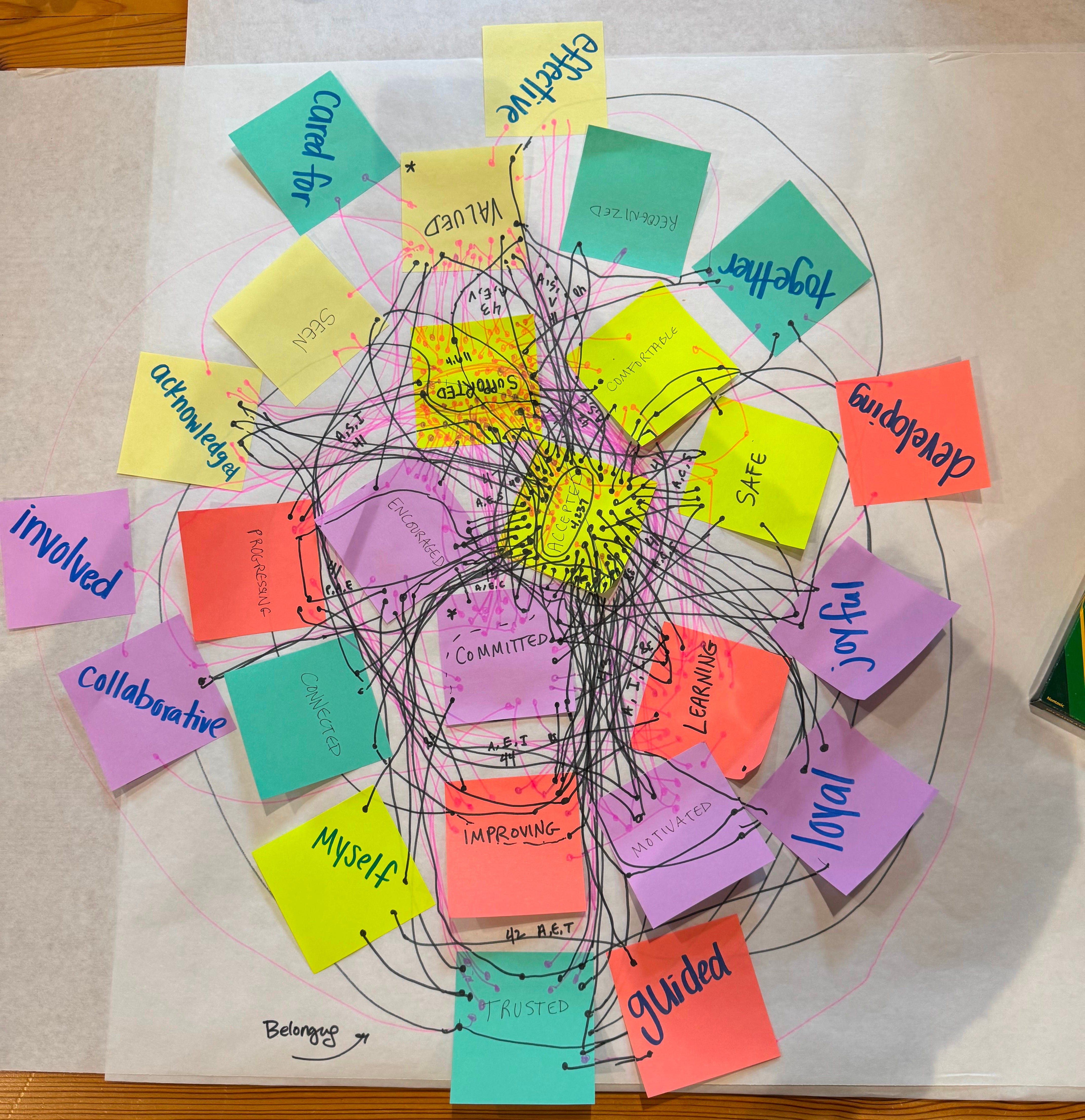
Here’s what we did: we took a data dump of the top combinations of three sentiments, made a post-it note for each sentiment, and then connected each combination. We worked through it using the most common words first, so all of the 3-word combinations that included the word “accepted” for instance. The combinations realated to the word “accepted” painted a picture around the concept of belonging and support that I hadn’t considered before.
It got quite messy, rather quickly. But what we saw emerge from the data is changing the way I think about our product and how we accomplish the greatest level of impact as a company.
We started to see common words in those combinations. We called those “anchor words” when they showed up in hundreds and hundreds of combinations, because it felt like they were at the center of the overall theme. We found about 12-15 of those anchor words overall. Each of them became the center of a little network of related words.
We also found that there are words that are very closely related even if they’re not synonymns at all. Like “supported” and “accepted.” Essentially, we know that when teachers say they feel accepted, they are much more likely to also say they feel supported. Watching our educators develop hunches about these combinations was so much fun — they would say “Oh, I get it. That combination sounds like newer teachers” or “That combination feels like it’s a school with awesome professional development.” I can’t wait to prove out these hunches and connect them to our resources.
What’s emerging for us through this data is the beginnings of a framework to understand school culture that is built completely out of the real words real teachers use to describe work. I think as we pull this into a mode more robust than post-it notes and markers, we will see some clear school culture “archetypes” arise from the data — profiles of school culture that emerge when many teachers describe work in the same way. Perhaps a school’s sentiments indicate a culture that is ambitious and energetic, but prone to burnout or fatigue. Another school’s staff sentiments might indicate a culture that is supportive and accepting, but that can be lonely or isolated.
If we get it right, this framework builds a new language for us, and for the school leaders who survey their teachers with Alpaca — to understand both the school culture they have today, and the school culture they want to build for the future.
A framework like that can guide our products too — think about an Alpaca pack built for teachers who are well supported but struggling with isolation. Or resources like a staff meeting agenda built for teachers who are seeking mentorship and growth.
When we can name the school cultures we see, then school leaders can create the school culture they want; a culture that reflects the values of their whole team and supports them well in the profession of education.
In case you can’t tell, I am dorked out by the possibilities, y’all!
I hope you’ll continue to get curious about the data and about teachers’ experiences in this way. When you’re at conferences in the next few weeks, listen carefully for the combinations of words educators use to describe work.
Think about the aspects of our organizational culture that you love, and the components you might change. Above all — listen to teachers, listen to teachers, listen to teachers. We have ample opportunities at our fingertips — let’s get out there and listen.
We’re on to something big, Alpaca. It’s early days and a work in progress — let’s KEEP GOING!
KB
PS: Highly recommend thinking something through with a couple of teachers and a stack of post-it notes.