

April 27, 2026
At Alpaca, our #1 core value is Listen to Teachers.
It’s what our entire company was built on. Before we even started the company, I wanted to make sure I wasn’t inventing a solution for a problem I didn’t understand. So before I wrote the plan, I took coffee to dozens and dozens of teachers after school. I toured their classrooms, sat down in their tiny chairs, and said “Tell me about your work as an educator.”
We built our very first teacher recognition program based on what we heard in those classrooms, and we’ve built every product and feature since based on listening, listening, listening to teachers.

Late last year, we realized we had the opportunity as a company to listen in a bigger way. In December, we put out a call to our Little Wins Newsletter list (mostly school and district leaders) to take our School Culture Survey, an in-depth listening survey to understand where leaders feel great about their school culture, where they’re challenged, and what they see changing. We were overwhelmed with the response!
We then realized that we could analyze the leadership survey data alongside the pulse survey data we get throughout the school year from teachers, as well as the in-depth interviews we’ve done through the Little Wins Podcast’s first season, to create an unprecedented look at school culture in the US, right now.

Today, we’re publishing The School Culture Report 2026, and you’ve got the first look at it!
I’m beyond excited! Here’s what’s inside:
Whose voices are here
There are a lot of voices in this report, friends. Here’s what you’ll find here:
Pulse responses from 33,144 educator surveys across 280 schools and 34 states, gathered over eight months (August 2025–March 2026).
A national survey of 155 school and district leaders across 35 states. Every role on campus — classroom teachers, paraeducators, specialists, school staff, administrators — is in there. Every community type, too: rural, suburban, urban. It’s the most representative listening exercise we’ve ever done as a company.
38 interviews with school and district leaders from the Little Wins Podcast
What we learned
Where to start!? When we combined these different voices (educators and leaders at the school and district level), we saw a unique look at what’s happening in schools today. Here are some of the biggest things we learned:
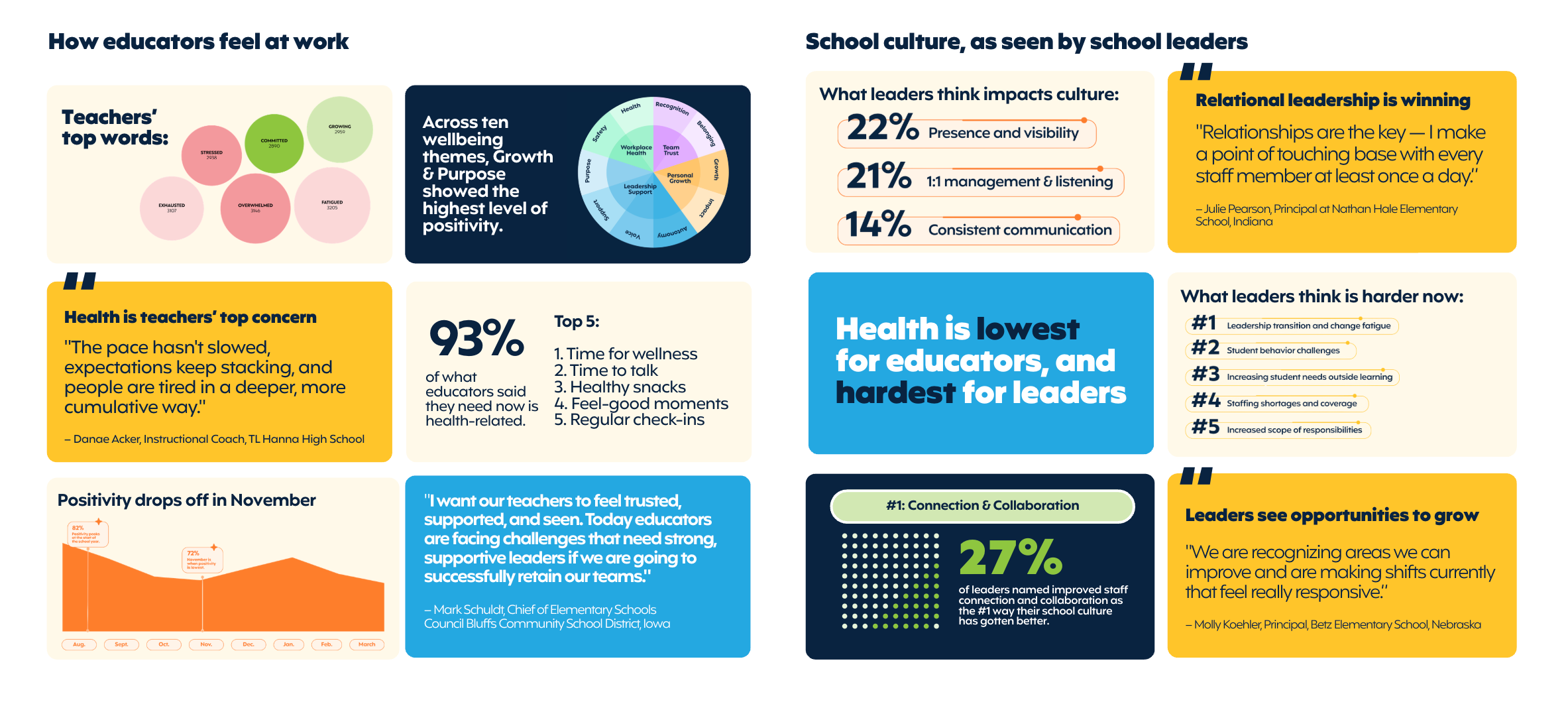
For me, there were a few important takeaways:
Health and wellbeing is the big story.
Across ten wellbeing themes we measured, the area where educators expressed more negative sentiment than any other was their own health and wellbeing. And when we asked leaders which area of school culture they find hardest to support right now? The very same thing.
“The pace hasn’t slowed, expectations keep stacking, and people are tired in a deeper, more cumulative way,” said Danae Acker, Instructional Coach at TL Hanna High School in Anderson, S.C.
So we have leaders everywhere who know their teachers’ health is the thing, and that is the thing they feel least confident about how to support. And yet, our leaders do know what does move the needle for school culture: relational leadership that emphasizes connection and personal relationships.
Connection is winning. When leaders told us what’s getting better in their school culture right now, the #1 answer was staff connection and collaboration. 27% of leaders named it as the single biggest improvement in their school culture.
“Relationships are the key — I make a point of touching base with every staff member at least once a day, to ask about something personal or professional, but just to talk to them,” said Julie Pearson, principal at Nathan Hale Elementary School in Whiting, Indiana.
The leadership practices leaders themselves named as most impactful for school culture — presence and visibility, 1:1 management, consistent communication — are the exact practices they wish they were doing more of. Leaders know what works. They are, by their own admission, doing less of it than they want to. “Leaders are stretched, and the relational work is the first thing that gets squeezed” is the way we heard it directly from the leaders.
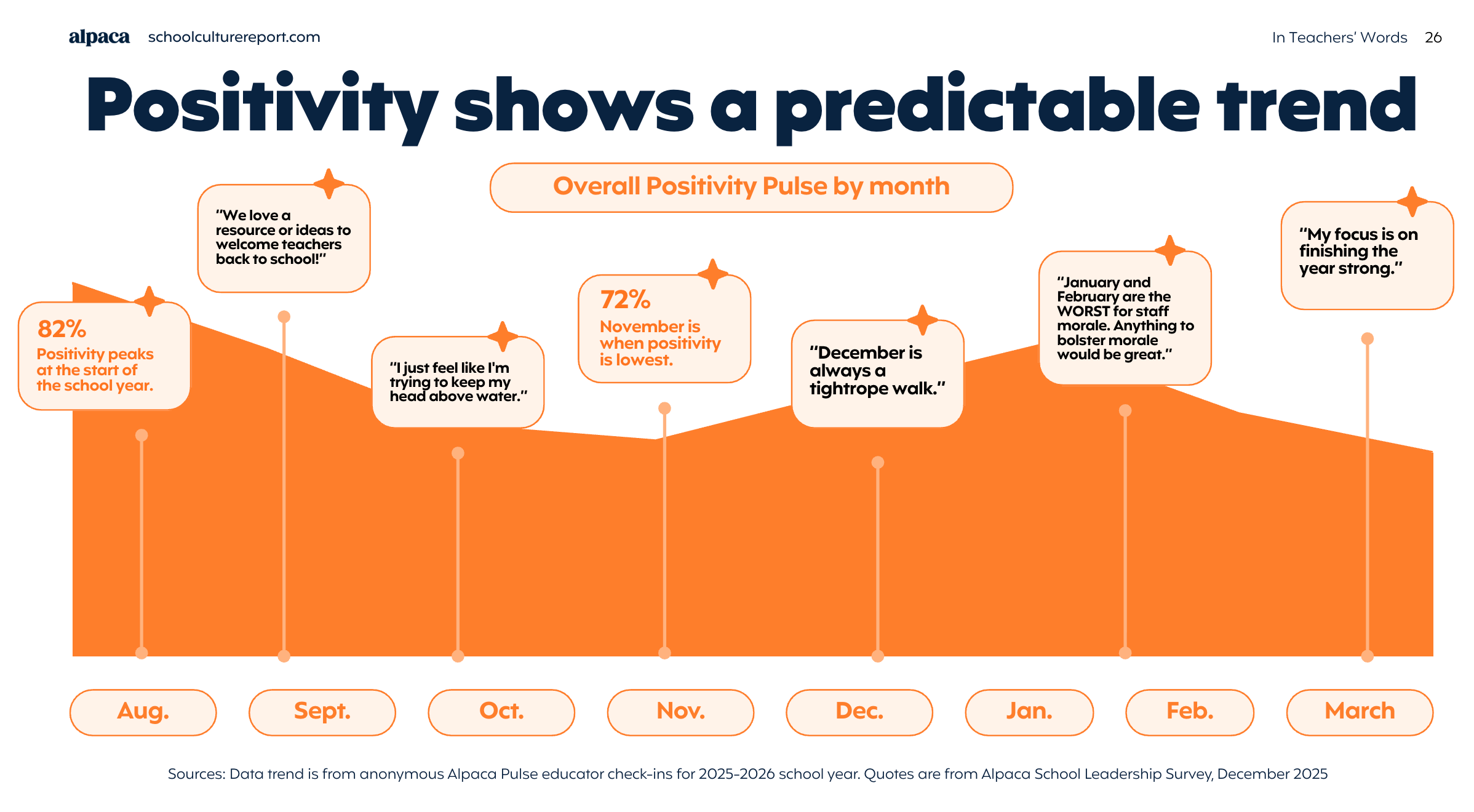
The work in front of school leaders today is to find opportunities for the connective, relational work that they know builds stronger culture. That’s what the back half of the report is about: ten leadership practices, filled with some of the best practices in school and district leadership we’ve heard. This section has real examples, tips and ideas, and key insights about leadership practices like 1:1 management, communications, meetings & gatherings, and seven more.
I’m so excited for you to read it, share it, and for us as a company to continue to learn from it. I’ve read every single response from leaders in building this report, and I hope you’ll read it with a pen and highlighter in hand and the question in your mind:
“How can we use this listening to build Alpaca to support what leaders need today?”
A massive thank you to the Alpaca team — every one of you put hands on this in some way: on the survey, the writing, the design, the imagery, the editing, and the support to make sure we’re representing each voice with accuracy and care.
I hope you enjoy learning from this report, and finding new ways to connect to our core customers through this resource. Here’s my ask of you:
When you see or meet one of the 155 leaders who answered our questions, the podcast guests whose ideas helped shape the practices, and the thousands of educators whose voices anchor every page of this thing: tell them thank you.
And then buy them a coffee, go visit their classrooms, and listen some more.
With Gratitude,
KB