

October 22, 2024
Every week, this job gives me the chance to have the most incredible conversations — with educators, with entrepreneurs, and with leaders in the space. This week’s conversation was so cool, I had to share it with you. Here we go:
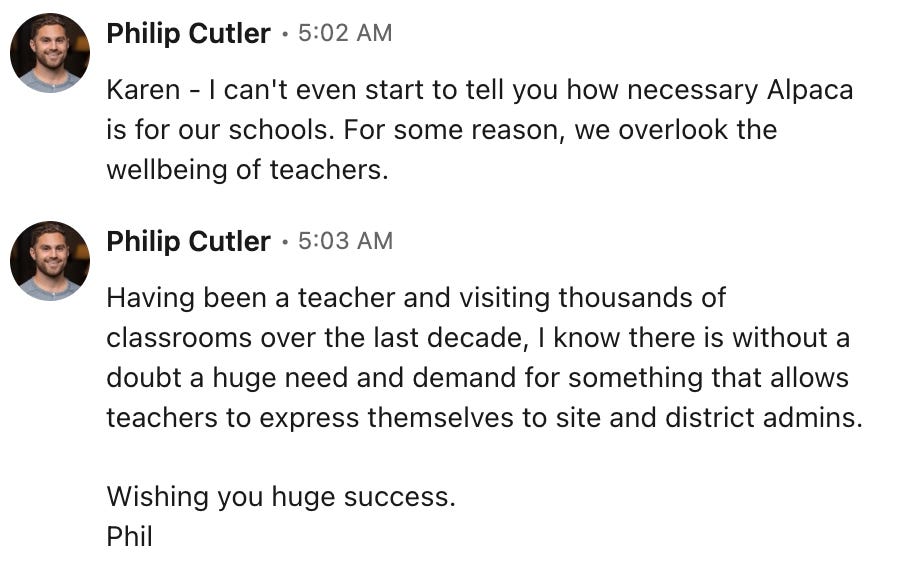
When this message hit my inbox — I freaked out. Partly because it’s awesome when someone really “gets us,” and partly because the message came from Philip Cutler, a founder whose work in EdTech I have been following for a long time, and whose company, Paper, has done BIG things in our space. They’ve had their challenges, too, of course. But their story is extraordinary, and I was excited that Phil reached out.
Paper’s tutoring platform is a billion dollar business (yes, with a B). Their product is simple and excellent, their brand is outstanding, and they’re unafraid and unapologetic about who they are in the world. They knew chat-based and asynchronous education was going to be huge long before the pandemic. (I’ll tell you WHY they knew that in a minute).
Don’t worry guys, I played it super cool and did not immediately send 3 messages back, including one asking him to meet up that day in New York. I did do that. I’ve never been accused of having any chill.
I got the chance to chat with Phil this morning, and 90 minutes later, my notebook was full and my brain was zooming. His advice and ideas are so SO good for all of us, so I had to share it so we all know it!
Here’s what I learned:
1. Don’t just “talk to customers.” Go be with them.
This should be #1, 2, and 3. Phil was really candid, that growth for their company didn’t come easily at first, and according to him “it was mostly my fault. I had to learn some lessons.” He went on: “it is all about time in market. Not just going and talking to customers or asking for their satisfaction score. I mean go BE with your potential customers. Go spend a day with a superintendent and watch how they spend their day. Go sit all day in the office of a principal. How many fires do they put out in a day? What problems get them down, and which ones get them excited? What do you literally hear and smell, what do you see on the walls?” Then, the important part: “every time, ask yourself ‘How does what we do solve the problems this person has? How would THEY say that?”
This is why Listen to Teachers is one of our core values. It’s why Alissa substitutes on a regular basis! It’s why we attend so many conferences. And it’s why we delivered packs by hand this week — to experience our customers’ days. We can do even more of this, and we should. This is your permission slip: go spend a day with an educator any day, ever.
2. A contract isn’t just a contract.
I asked Phil, “what was the catalyst for growth for you, like when did you start to REALLY see the wheel start to turn? Phil answered “I know the exact moment, actually. It was the first time we got a district contract in the door. That contract wasn’t a big deal financially, and my coworkers were like ‘why are you so excited about that?’ But what I knew is that if we could sell one district contract, we could sell a lot of them. So that contract wasn’t worth five figures, it was worth millions, if we could replicate that sales motion over and over.
This is why every single booth demo, sales effort, proposal revision, and customer contract matters. If we can sell one, we can sell 20. (and we can!). And if we can sell 20, we can sell 100. And if we can sell 100, we can build a big company. Let’s keep at it, y’all. I will if you will will.
3. Think about problems, not solutions.
This was an eye-opener for me. I said in the conversation “no one really asks teachers how they’re doing, or does surveying about wellbeing.” Phil didn’t move swiftly to Alpaca Pulse or our offerings, he asked this: “Why do YOU think that is?”
It led to a great conversation about employee experience and how it has evolved over time in the private sector, and how it has not yet become “a thing” in K-12 education. We talked about teachers who never view themselves as professionals, and principals who never see themselves as leaders of teams or as people managers.
So, if this is the case, we need to ask ourselves: if educators don’t see themselves as professionals, why do we think superintendents see “employee engagement” as a problem they need to solve? The truth is, they may not yet. And it’s our job to help create that understanding (and in turn, the urgency that goes with it).
4. Does your solution meet a market need? Don’t be afraid to ask people to pay for it.
Phil’s company grew a lot during the pandemic, which is understandable, because every school and district was scrambling, trying to figure out how to help kids learn at a distance. Paper was very clear about their role here. As Phil said, “we knew the market had a need and we had a way to fill it. So we sold clearly and aggressively to that market at that time. And we solved big problems for districts.”
We’ve been told before that our highly positive, cheerful brand doesn’t talk much about the problem of teacher retention and teacher morale. I love that we focus at our company on the solutions we provide. But, Phil’s advice (and I agree with it), is to do more to clearly articulate the problem we can truly solve for a school or district. “Help them understand that getting a pulse on teacher wellbeing needs to be a priority, right now. Because you’re right — it does, and you have a solution that helps.” Good advice.
5. Companies don’t need investors. Companies DO need customers.
This may sound elementary, but it’s easy in the Edtech/ Startup/ High growth world to place the emphasis and focus of our energy and time on raising our round or finding investors. RIght now, we’ve made a decision to raise a round to achieve some very specific growth goals, so investors ARE important. But it’s key to never forget that when it comes down to it, companies can survive without venture capital (we ALL know companies who have never taken investment!), but companies cannot survive without paying customers.
What does that mean for us? It means we focus on the GoTo Market strategies we’ve been chatting a lot about lately:
Thought Leadership
In-Person Events
Email and drip campaigns to districts
Alpaca resources/ Content that generates demand
I’ll keep working to close out our fundraising round, but I’m not going to lose focus on those 4 things — I ask that we all share that priority, and I think this team is doing a tremendous job of that.
The conversation was helpful in two big ways: it feels like our instincts are correct, and it feels like our roadmap is clear. Our instincts are good - we’re doing a lot of the things Phil suggested as far as our focus and energy. That’s always reassuring to hear. But more importantly, our roadmap is clear — we have big BIG work to do in the next several quarters, and our job is to follow that path without getting distracted.
In case you need the short reminder of what that path is, it’s this:
Relentlessly spend time with educators at every level. Customers or future customers, but do it every week.
Own the conversation that listening to teacher input is crucial to teacher morale and, by extension, teacher retention.
Pursue sales to school and district customers as our first priority as a company.
Just those things! We can do that, right Alpaca?
See you Thursday — I can’t wait to do more big work together.
Let’s go!
KB
This team letter is published with Phil Cutler’s permission. Thanks, Phil!