

February 3, 2025
Happy February, Alpaca!
I love new months. And new notebooks. Even Mondays. Ah, beginnings!
There’s so much ahead of us at every beginning — big things to accomplish, big lists to knock out, big sales to make. At every beginning, we have a big week of effort ahead of us, and by nature, I love audacity and the allure of putting in big effort for big results.
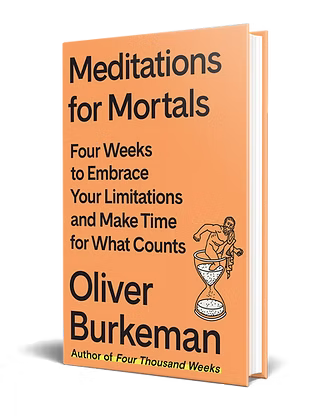
And that is why, when I recently picked up Oliver Burkeman’s book Meditations For Mortals, I nearly threw it across the room.
Because right there, halfway through this book on ambitious work and productivity there was a chapter called “On the false allure of effort.” (Honestly, how dare he!)
Burkeman’s theory is that as ambitious, energetic professionals who want to do big things in the world, we have created a (false) narrative that says this:
Anything that is worth doing is going to be very, very hard.
and ALSO:
If I am working very very hard, it’s probably really important stuff.
Burkeman warns that this is a trap we’ve created for ourselves that hurts us in two ways. First, when we believe that anything we’re doing has to be done “the hard way,” we miss opportunities for little wins. And second, we believe that if we’re dog tired from our efforts, they must have been the right ones.
Last week, I found this lesson written in bold print throughout my meetings and travels with customers, investors, and new partners.
Here are the questions I asked myself:
1. Does the biggest impact require the hardest path? (Hint: nope.)
Last week, I spent an extraordinary afternoon with our new investors, whiteboarding product ideas and discussing our Go To Market and our plans for growth, which includes selling to both schools and districts (as you know).
At one point in the day they asked, “Have you modeled the idea of building your business by selling ONLY to single schools and not to districts?”
They went on: “Because selling to districts has a higher contract value, which is great. But when you aren’t as proven as a product, the process takes longer, it’s more expensive, and if one of them leaves you, it’s harder for your business. Could you make it work if you ONLY sold to single schools?”
My brain broke.
All this time, I’ve been 100% sure that our only way to success as a company is to climb the BIG mountain of selling to school districts to achieve an average contract size that we believe moves the needle for our company.
To put a further point on it, I’ve believed that in order to be successful, we were going to have to do the “hardest thing.” By being myopic about districts, I was ignoring the extraordinary and delightful relationships we’re building by delivering a great product to single schools buying Alpaca to support their teachers.
Do all the maths add up on a “schools only” strategy? I’m not sure yet. But I think that they can, and more importantly, I think it’s important for us to understand the answer to that question.
So I’ve spent the last few days exploring a model that answers the question “How many single schools would we need to bring Alpaca to, in order to make a BIG impact in the market and on our company?”
What I learned through the process is that the important thing isn’t whether the efforts we’re making represent the hardest, most prestigious, most highly regarded path. Because the most important path is the one that achieves our goals, with the greatest level of efficiency in our time and resources.
Which brings me to my second question:
2. Does all effort create the same impact? (Hint: nope)
The other side of Burkeman’s lesson was just as big for me. His example was this (And I’m paraphrasing): Let’s say you spend all day one day filing every single email you’ve ever received into a perfect filing system — a folder for every purpose, each email tagged and categorized, each item filed away exactly where it should be, inboxes at zero. You’re exhausted — of course you are! That effort required a lot of mental energy, time, and decision-making.
But… what if the search function in your email could have allowed you to simply archive it all and then find what you need just as quickly, without having to create an enormous filing system and spend 8 hours perfecting it?
In other words: what if all that effort didn’t actually save you time or help you be more productive in the long run?
(Dying. Honestly dying.)
It’s a killer question for me personally, because when I get home at the end of a very long day of work and I’ve got limited time with family, and my social battery is low, my tendency is to say “but all that work had to be IMPORTANT, right? If I’m this tired, I’m doing something important and necesssary.”
And most often, the work we do each day is important and necessary. But sometimes friends, sometimes it isn’t. (sorry! I know!)
Sometimes, we spend time on things that are not the highest and best use of our time. Or we waste time trying to do it ourselves when we could have asked someone for help. Or we don’t listen to what is truly needed and we run off in a direction that doesn’t actually move the needle. Or we waste 15 hours of our time to save $50.
I am guilty of all of this.
So, I spent this last week being incredibly aware of my efforts: which ones felt like a door opening? Which ones felt like an effort that enabled three other people to stay on track? Which ones felt like they moved us truly forward? And which ones weren’t going to make the difference right this minute?
Because of my choices about my efforts, some of you didn’t get a few things that you needed. And because of those choices, I was less present in our office and with our team, but more present with our customers, investors, and potential partners. Is that what we always need? No way. (And I cannot wait to see you this week!) But is it what was right for us last week? I believe so, and I’m eager to learn if I was right.
Three questions to ask ourselves this week
As a company right now, we’re REALLY focused on activities and efforts. We’ve never had sales call goals or email activity goals or event demo goals before. We’ve never had so much to do, or so many decisions to make about how we spend our time. And we’ve never had a greater opportunity to win.
So I believe the time is right to consider this lesson, and to ask ourselves the following:
1. Are my efforts giving me the results I want?
2. Have I considered a more efficient or better way to accomplish this result?
3. Is the work I’m doing the highest and best use of my time?
If the answer is no to any of these questions, I invite you to try the following:
Tell me. Let me know if you think there are efforts that aren’t giving you results, or if you think there’s a better way to accomplish the same result or better. It’s ok to say “I’m not getting the results I want. Help.”
Do the math. Find out what it would cost to do it a different way — and assume that you HAVE to. Literally price it out, so that we can understand the trade-offs and make decisions.
Test a day. Spend one whole day doing ONLY things that you believe are the highest and best use of your time. Make a list of what didn’t get done, and schedule time with me to discuss it. (also, try and do #2 before we meet)
Oh, and please, read Meditations for Mortals. It’s not a meditation book. And it’s not a productivity book. But it did shake the core of some beliefs I have about work, and I think it’ll do the same for you.
It’s designed to be read in 28 one-chapter chunks, and they’re about 8 minutes each on Audible. We’ll buy it for you if you’d like to read it, and I truly invite you to do so.
In the meantime, let’s kick off February with the work that matters.
You know our goals.
You know your role.
You know we trust each other.
Let’s do the work that makes the difference, and if we need help, let’s say so.
Above all — LET’S KEEP GOING.
Onward, Alpaca!
KB