

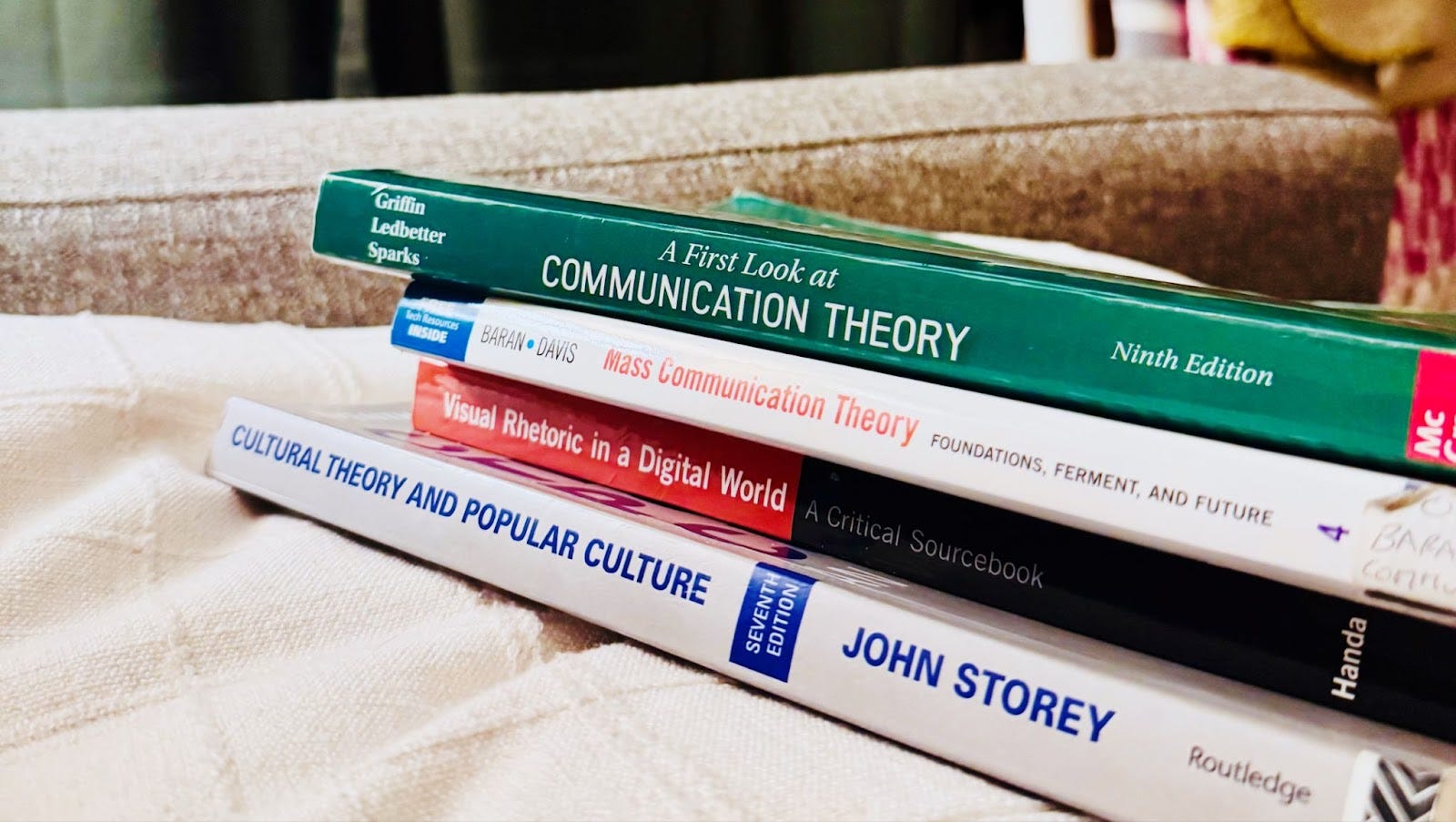
Today’s Team Letter is a guest post from Head of Marketing Kimberly Bailey, who is currently finishing her Masters in Communications degree from the University of Nebraska at Omaha. Her work is shaping our understanding of the words used to describe educators, from print media to teachers’ own stories. Enjoy!
Hi team!
As many of you know, this spring I wrapped up the final required coursework credits in my Masters of Communication program at the University of Nebraska at Omaha (insert a quiet fist pump at my kitchen table and a very relieved laptop close). For my class, I designed and piloted the study, methodology, and protocol I’ll use for the final research project to close out my degree. The research this spring took me into some deep, nerdy, meaningful waters that directly tie to what we care about at Alpaca: listening to teachers and telling meaningful stories about their work.
The question I landed on soon after the semester began was simple-but big:
What recurring themes define the portrayal of teachers in U.S. print news media from 2021 to 2025?
We’ve all seen the headlines: burnout, resignations, staffing shortages. But I wanted to zoom out and ask, What do these headlines add up to? What meaning is being constructed? And what does it tell the world about what it means to be a teacher right now?
The Why: Framing, Agenda-Setting & Media Meaning
I geeked out on two core communication theories to focus the study:
Framing theory helps explain how media stories emphasize some parts of reality while leaving other parts out. It's like editing a photo—what you crop, filter, or highlight can completely change how the image is seen.
Agenda-setting theory says that while media might not control what we think, they do control what we think about. And repeated coverage shapes our mental list of what matters.
These two theories gave me a structure to understand how stories about teachers are shaped, repeated, and internalized—both by the public and by the educators living those stories every day.
The Research Approach: Grounded Theory + Content Analysis
I analyzed 15 articles about teachers published between 2021 and 2025 in The New York Times, Washington Post, USA Today, Wall Street Journal, and LA Times. These weren’t quick blurbs. They were in-depth, narrative-style features that met a specific set of inclusion criteria: each one focused on K–12 teachers, included direct quotes from educators, and offered enough emotional and narrative depth to analyze how teachers were portrayed in public discourse.
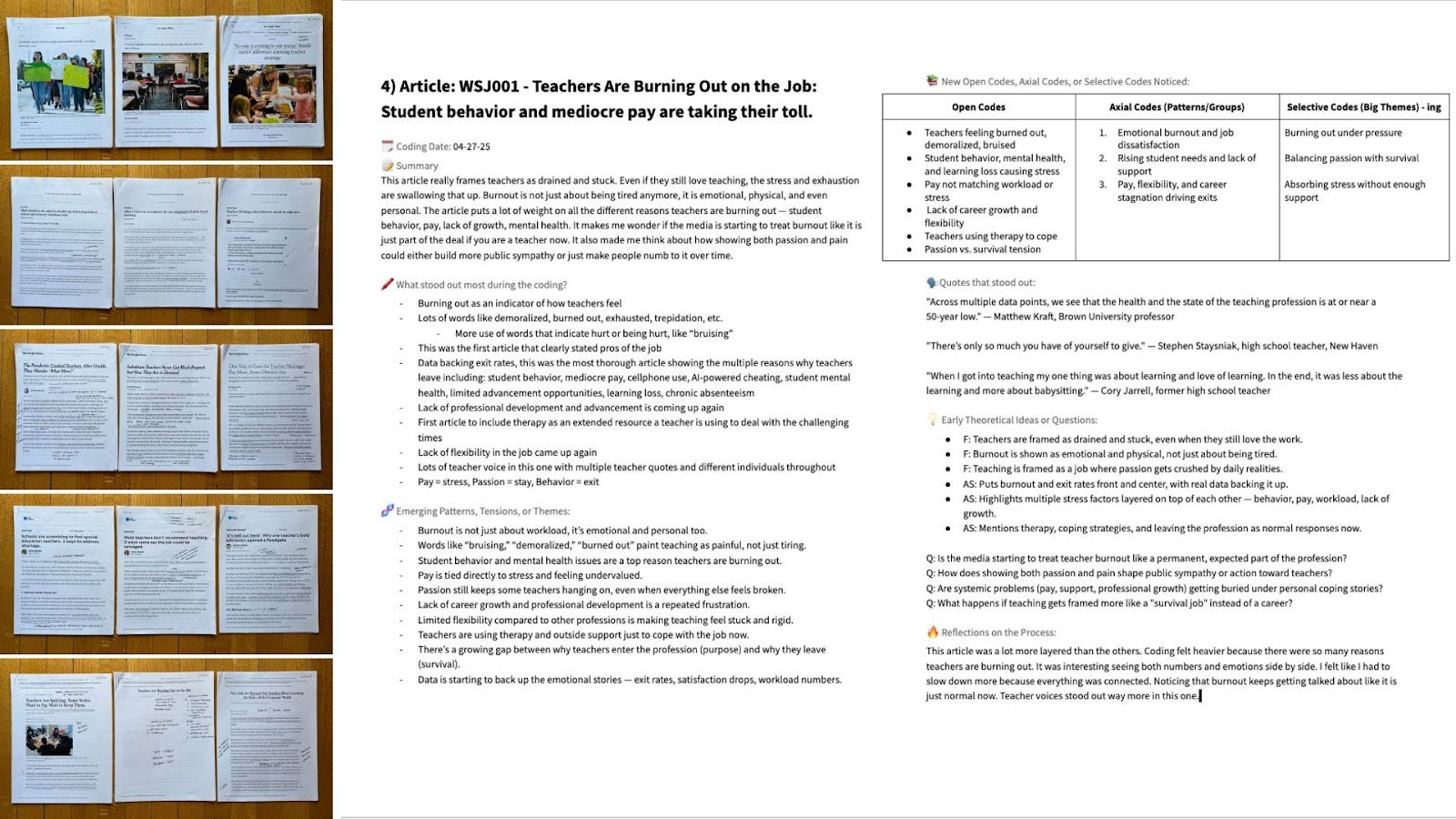
I used an approach called grounded theory, which is basically a way to let themes and patterns emerge from the data instead of starting with assumptions. First, I looked at each article in a very structured way—lots of spreadsheets, codes, and categories. Then, I stepped back and asked, what’s the bigger meaning here? What emotions are coming through? What stories are being told?
To support that, I used something called qualitative content analysis—kind of like puzzle-building with words. Piece by piece, I looked at how language and patterns added up.
There were checklists. There was a beautifully formatted memo journal (see below). There was a tracking spreadsheet that I am (admittedly) very proud of.
What I Found: The Patterns We Keep Seeing
Across all 15 articles, eight themes kept surfacing:
Burnout is framed as structural, not emotional
Love for the work doesn’t outweigh the cost
Crisis framing dominates the narrative
Systems are reactive, not proactive
Invisible labor, especially by women, goes unnamed
Respect is the missing piece
Private sector roles are framed as more sustainable
Hopeful stories are the exception, not the norm
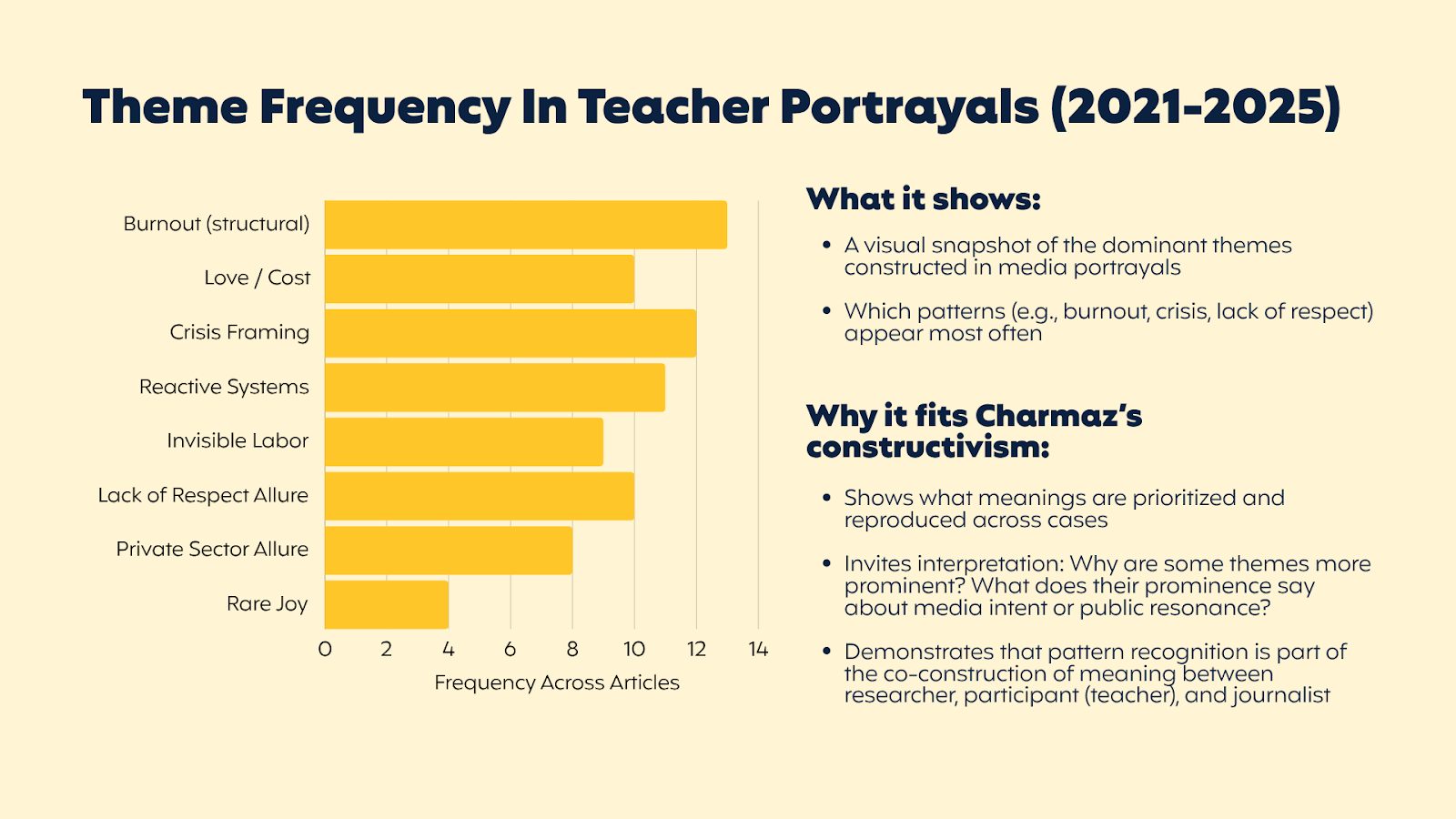
Burnout dominated. Teachers speaking about respect was hard to find. And joy? Nearly absent in the 15 stories I analyzed.
The frequency chart shows clearly: media stories overwhelmingly lean into narratives of exhaustion, crisis, and systemic failure. Most stories frame teaching as unsustainable. Moments of joy, resilience, or affirmation are so rare, they appear as anomalies rather than possibilities. It paints a stark picture as well as a very narrow one.
One direct quote from a teacher recounting the burden of post-COVID era hybrid learning stuck with me:
“It’s the hardest thing I’ve ever done. I was absolutely exhausted, just sort of existing.” — The Washington Post
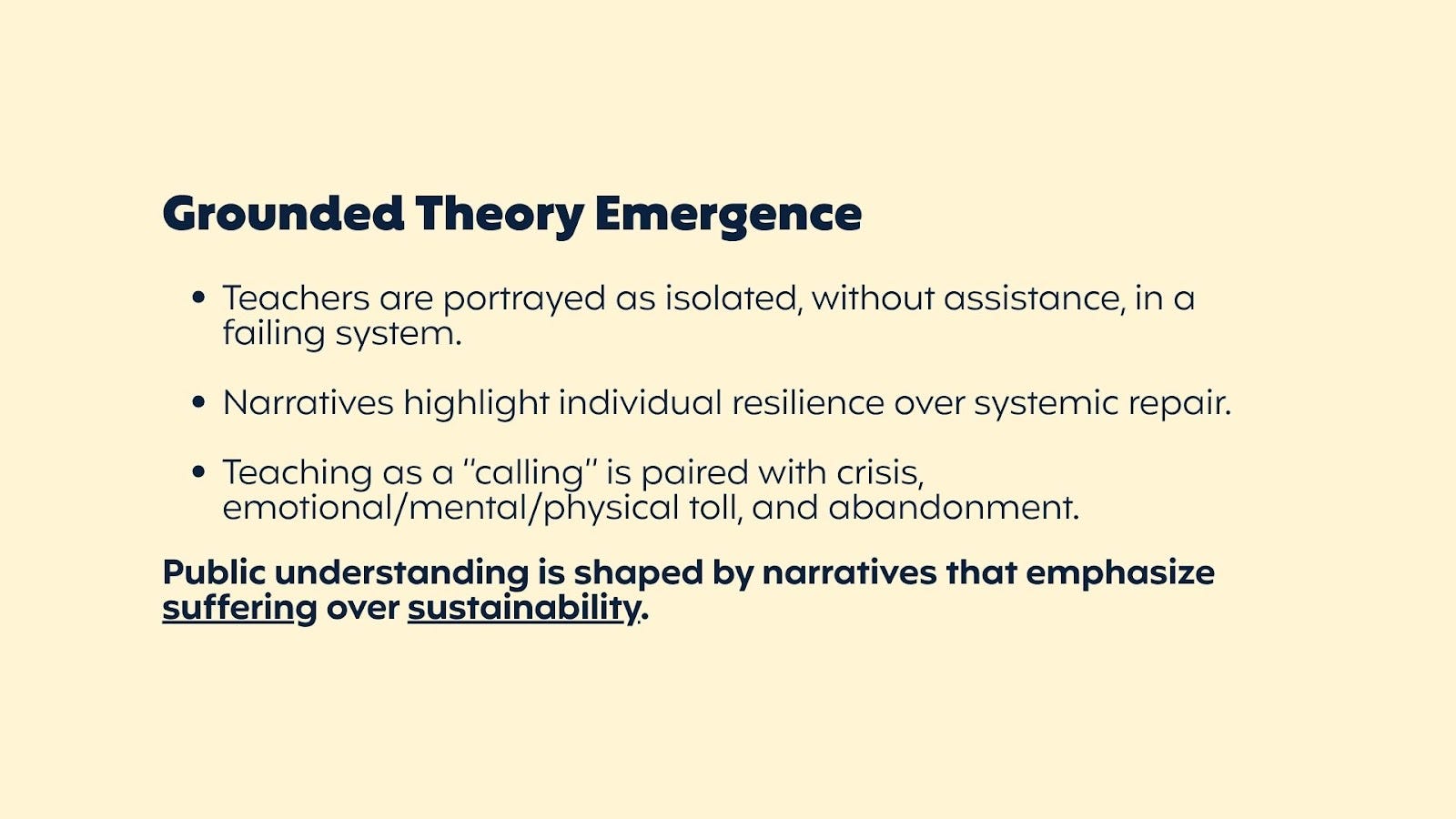
These weren’t stories of personal failure. They were stories of teachers trying to do their jobs, often brilliantly. The challenges weren’t about effort or care. They were about structure, support, and sustainability.
This wasn’t just an academic insight backed by research and a solid methodology.
I was talking to my mom about the project, explaining the kind of content analysis I was doing, and she said, "Yeah! That’s right. The only positive stories you hear in the news about teachers are when they win an award." I gasped… because she was absolutely right. Of the articles I analyzed, only one met all of my criteria and was framed positively. And yes, it was a story about the Washington Post Teacher of the Year.
What made it even more powerful was that she represents the general public—the audience this media is shaping. While we at Alpaca are deeply immersed in this space, with our own data, research, and day-to-day interactions with school leaders and teachers, her quick comment cut right to the heart of what I spent weeks analyzing. It reminded me that these narratives aren’t just academic—they’re absorbed, repeated, and believed by people everywhere. And that’s why they matter.
Why It Matters to Alpaca
Reading and coding these stories, I kept circling back to Alpaca’s values:
Listen to Teachers
Tell Stories
The media is telling stories about teachers. Stories set in a world of isolation and exhaustion. And yes, these stories are very real, as seen in the research and articles analyzed.
But they’re not the only ones recounting stories. So are we.
At Alpaca, every Pulse check-in, every Pack, every Little Wins email we send is not just a tool or a resource. It’s a story. One of teachers as professionals doing meaningful work that deserves real support, not just admiration from afar. They build culture, lead learning, and carry more than most people see. And stories about them should be seen in full color with all the nuance and joy that often gets left out when the story starts and ends with crisis.
As a team, we’re building something different—something rooted in community, capacity, and the kind of joy that doesn’t ignore the challenges but exists right alongside them. We know that education is full of bright spots and we get to bring those moments into focus.
We help school leaders build great school culture through leadership tools and systems that are sustainable and helpful, not overwhelming or performative. We help them see their teams more clearly, support them more intentionally, and celebrate what makes their culture unique. We’re not just offering tools, we’re offering a different story. One where schools can truly be the happiest places to work.
We’re helping fill in the gaps of stories we see and understand in the world of education. And we’re doing it together.
What’s Next
This pilot was just the beginning. I’ll be evolving this with into my full research project this summer and fall, broadening the scope and tightening the focus.
I’m especially curious about how teacher portrayals vary across local versus national media outlets. My gut (and my mom) tells me that more localized coverage—especially in community-based papers—might offer a more hopeful, grounded view of teachers' work. I’m planning to dig in and see what emerges when the storytelling is closer to the source.
I’ll keep sharing what I find. And yes, you are all officially invited to graduation in December. 🤞
- Kimberly
Images included in the body above are from my final presentation slides (if you’d like to see)!
